Quality Improvement in Primary Care 2026 Accelerator
This course is for Practice & PCN Managers. Highly recommended bespoke training for H&F & all NWL practices & PCNs.
Click to see flyer in full and Register:
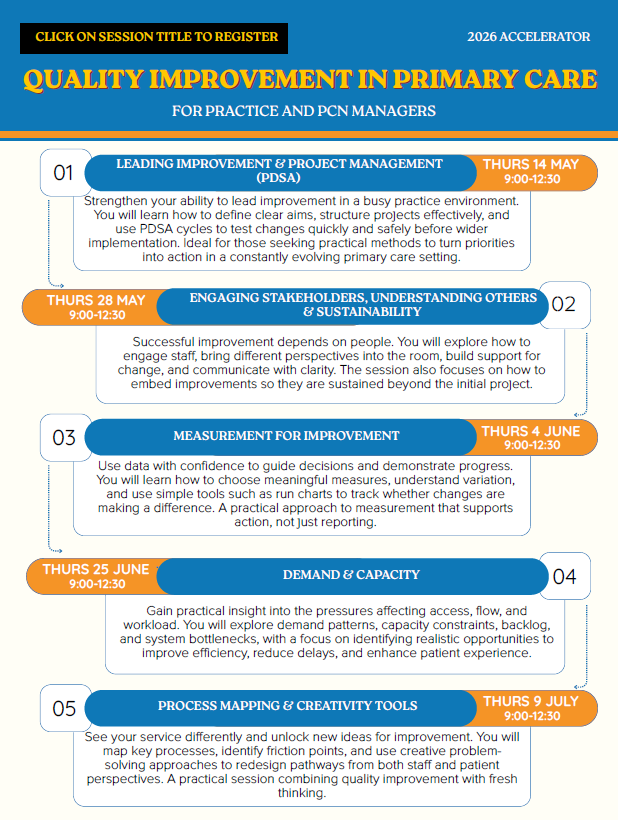
Quality Improvement in Primary Care 2026
Accelerator for Practice and PCN Managers
Each session runs on a Thursday morning from 9:00–12:30 and covers a different aspect of quality improvement, giving you practical tools and approaches you can apply directly in your setting. Sessions can be attended individually, so please book onto whichever are most relevant to you.
Session 1 — Leading Improvement & Project Management (PDSA)
Thursday 14 May | 9:00–12:30
Strengthen your ability to lead improvement in a busy practice environment. Learn how to define clear aims, structure projects effectively, and use PDSA cycles to test changes quickly and safely before wider implementation. Register here
Session 2 — Engaging Stakeholders, Understanding Others & Sustainability
Thursday 28 May | 9:00–12:30
Explore how to engage staff, bring different perspectives into the room, build support for change, and communicate with clarity — including how to embed improvements so they last beyond the initial project. Register here
Session 3 — Measurement for Improvement
Thursday 4 June | 9:00–12:30
Use data with confidence to guide decisions and demonstrate progress. Learn how to choose meaningful measures, understand variation, and use simple tools such as run charts to track whether changes are making a difference. Register here
Session 4 — Demand & Capacity
Thursday 25 June | 9:00–12:30
Gain practical insight into the pressures affecting access, flow, and workload — including demand patterns, capacity constraints, backlog, and system bottlenecks — with a focus on identifying realistic opportunities to improve efficiency and patient experience. Register here
Session 5 — Process Mapping & Creativity Tools
Thursday 9 July | 9:00–12:30
See your service differently and unlock new ideas for improvement. Map key processes, identify friction points, and use creative problem-solving approaches to redesign pathways from both staff and patient perspectives. Register here